Sakhanda Wire
NVDA $155.46 -0.44% MSFT $506.24 -2.27% GOOGL $280.20 -1.24% META $618.87 -1.20% AMZN $257.89 +0.05%

MarkTechPost

397 stories · all sources

MarkTechPost

Mistral AI previews 1.05-trillion-parameter Mistral Large 4

Mistral AI has released Mistral Large 4, also known internally as “Le Chonk,” as a public preview. The Mixture of Experts model contains 1.05 trillion total parameters, with 49 billion active for each token. It accepts images natively through a 1.6-billion-parameter vision encoder and supports a context window of up to 1 million tokens.
MarkTechPost

Reka introduces Rho-1, a 19B model for multimodal reasoning and robot control

Reka has released a research preview of Rho-1, a 19B model trained from scratch to process and generate text, images and video, while also producing robot actions. The system represents these modalities in one context and uses a shared KV cache, rather than passing tasks among separate specialist models.

MarkTechPost

JEPA-Anything applies factorized world modeling across seven domains

Researchers from PhAI Labs, CUHK, Fudan, Stanford, Oxford and Princeton have introduced JEPA-Anything, a domain-agnostic framework for predictive world models. Its Orthogonal Predictive Factorization (OPF) divides a JEPA’s latent target into four learned, non-overlapping subspaces, each handled by a separate predictor. The outputs are recombined with a Moore-Penrose pseudoinverse to form a complete latent state. Regularizers address orthogonality, inactive factors and encoder collapse.

MarkTechPost

Together AI launches beta CLI for open models in coding agents

Together AI has released Together Link, a free, MIT-licensed command-line tool in beta. It connects Claude Code, Claude Desktop, Codex, ChatGPT Desktop, OpenCode, and Pi with open models hosted by Together AI. The tool is available on macOS and Linux and requires a Together API key; installation uses one shell command.

MarkTechPost

Tutorial details streaming robotics training with NVIDIA Cosmos3-DROID

A tutorial presents an end-to-end robotics learning pipeline built around the NVIDIA Cosmos3-DROID dataset, while avoiding a local download of its 707 GB repository. The workflow begins by examining the LeRobotDataset v3.0 layout and linking information from info.json, task records, episode tables and dataset statistics into a metadata graph.

MarkTechPost

Reflection AI unveils Beam open-weight model for coding and agents

Reflection AI has introduced Beam, its first open-weight model, aimed at coding, reasoning and agentic workloads. The sparse Mixture-of-Experts system has 501B total parameters, with 23B active for each token. Reflection says Beam matches GLM-5.2 on reasoning while requiring three to four times less inference compute on its reasoning benchmarks. The company also acknowledges that Kimi K3 remains ahead in raw capability.

MarkTechPost

Yandex tests Sona as a single-stage recommendation model

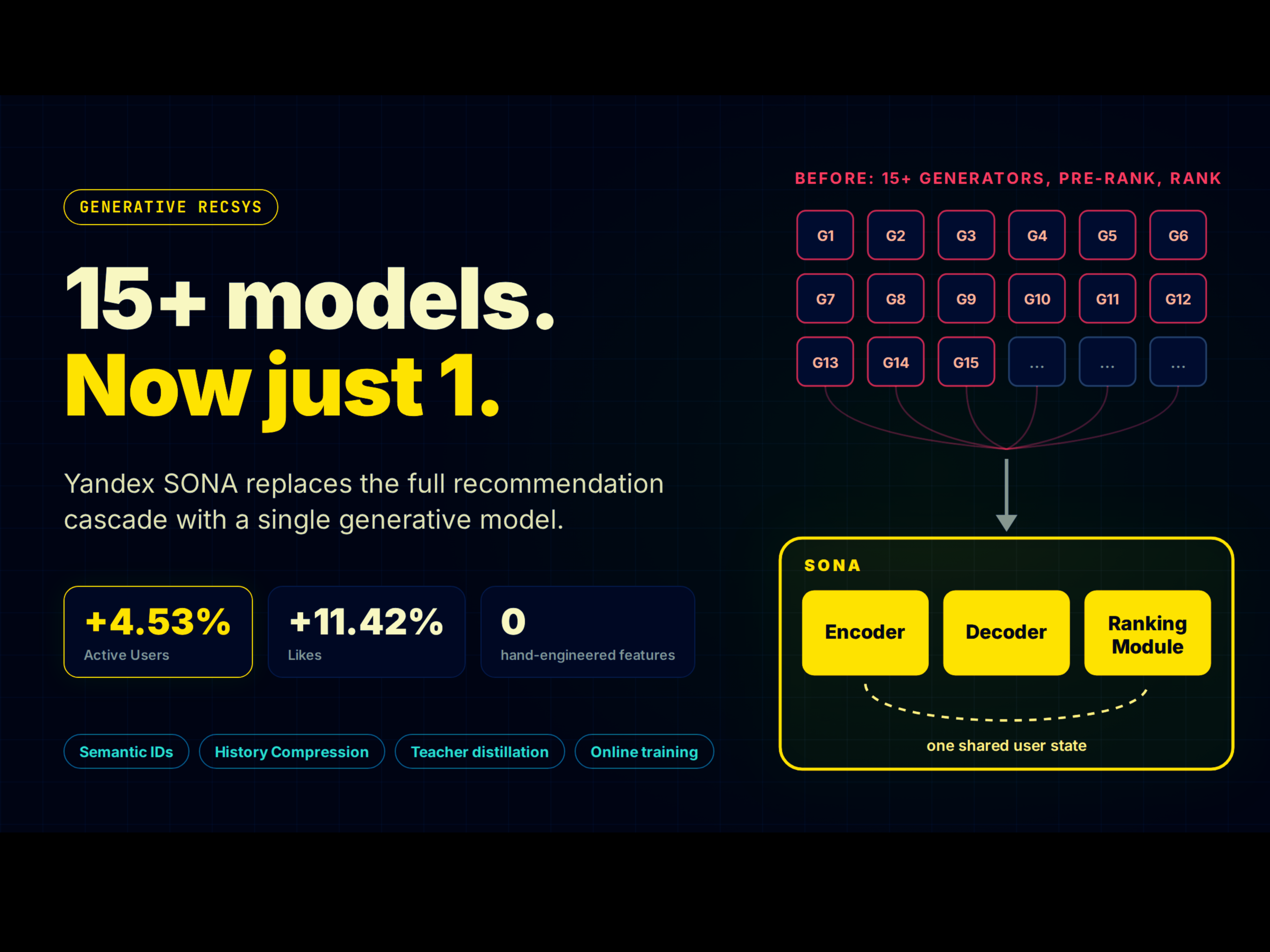
Yandex has tested Sona, a generative recommender designed to combine candidate generation and ranking in one model. In a seven-day live A/B experiment on smart speakers, the transformer replaced more than 15 candidate generators, pre-ranking and ranking stages for the test group. The system was evaluated on 15% of randomly selected users per split.

MarkTechPost

Qwen evolved from an enterprise chatbot to a 2.4-trillion-parameter model

Alibaba introduced Tongyi Qianwen to corporate users in April 2023 and opened the service to the public in September. In August, it released Qwen-7B and Qwen-7B-Chat, followed by vision-language models and larger 72B and 1.8B versions. The initial license allowed commercial use below 100 million monthly users.

MarkTechPost

Open security model solves 40 of 60 held-out vulnerability tasks

Cantina Security and Yeta Labs have released apex-flash-1, an open-weights model designed for vulnerability research. It is a reinforcement-learning fine-tune of Z.ai’s GLM-5.3-Flash and is available on Hugging Face under the MIT license. The model can run with vLLM, SGLang or Transformers, although its BF16 weights require roughly 640 GB of GPU memory.

MarkTechPost

Four frontier models differ most by workload, price and access

Four frontier models released by Anthropic, OpenAI and Google DeepMind within 30 days show broadly overlapping benchmark results, but larger differences in pricing and availability. GPT-6 Astra and Claude Fable 5.1 list input and output rates of $10 and $50 per 1M tokens. GPT-6.1 Sol costs $2 and $10, while Gemini 4 Argon has introductory rates of $2 and $10 before moving to $4 and $20. Argon is currently restricted to the Fairwind Program.

MarkTechPost

Google Moves Federated Learning Training Into Attested Server Environments

Google Research has presented a federated learning system based on Trusted Execution Environments (TEEs), saying it provides externally verifiable central differential privacy for federated learning for the first time. The design addresses an earlier trust issue: although Secure Aggregation protected uploaded data, it did not support some advanced central privacy methods, including matrix factorization DP-FTRL, and operators still had to be trusted to add noise correctly.

MarkTechPost

Aleph Alpha Releases 78.1B-Parameter Kolibri Model

Aleph Alpha has released Kolibri-1, an open-weight Mixture-of-Experts language model designed for English and German. The model contains 78.1 billion parameters, but activates 3.46 billion, or 4.4%, for each token. It supports contexts of up to 1,048,576 tokens and allows reasoning effort to be selected for individual requests. Its weights are available under the Apache 2.0 license on Hugging Face.