Sakhanda Wire
NVDA $155.46 -0.44% MSFT $506.24 -2.27% GOOGL $280.20 -1.24% META $618.87 -1.20% AMZN $257.89 +0.05%

Latest news

Older stories

TechCrunch

Safeworld tests robot safety with simulated human behavior

Safeworld, a startup founded by Carnegie Mellon University researcher Dr. Ding Zhao, Kyle Wong and machine learning engineer Simo Rachidi, is developing tools to assess whether generative-AI-controlled robots can operate safely around people. The company is emerging from stealth with a seed round of more than $12 million led by Shine Capital and a16z Speedrun, with additional backing from Box Group, the Carnegie Mellon University Endowment, Innovation Endeavors and SV Angel.

The Verge

Brain evolution extended control into the world

The article connects the development of intelligence with the changing possibilities offered by the environment. It describes this process through the biological history of the brain, from ancient fish and amphibians to mammals, primates and modern humans. As surroundings changed, new behaviors became possible and, over time, new abilities appeared.

MarkTechPost

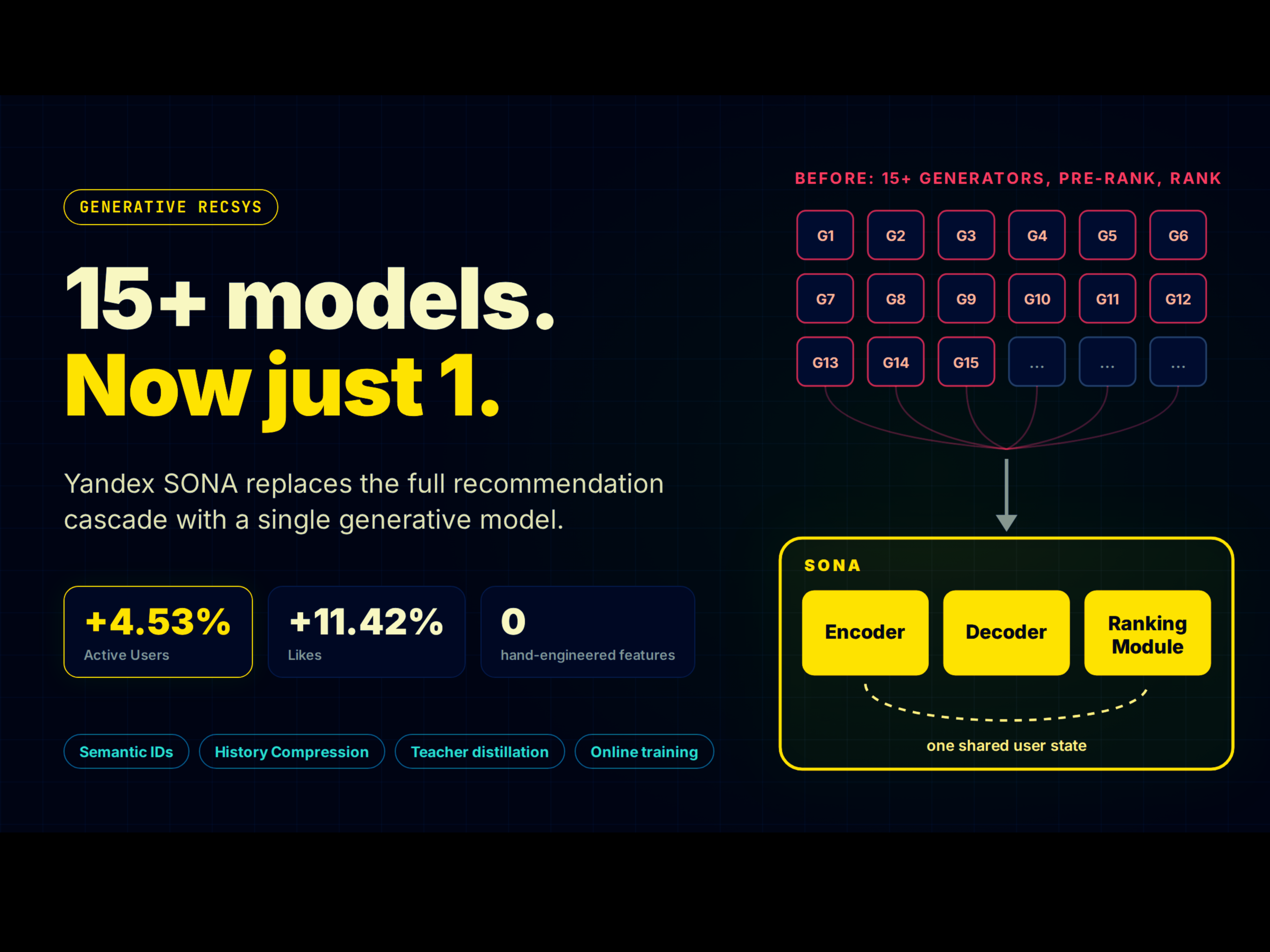
Yandex tests Sona as a single-stage recommendation model

Yandex has tested Sona, a generative recommender designed to combine candidate generation and ranking in one model. In a seven-day live A/B experiment on smart speakers, the transformer replaced more than 15 candidate generators, pre-ranking and ranking stages for the test group. The system was evaluated on 15% of randomly selected users per split.

MIT Tech Review

AI faces growing public distrust despite soaring use

Public attitudes toward artificial intelligence are becoming more negative even as use of AI tools expands rapidly. Pew Research Center found that more US adults expect AI to affect them and society negatively than positively. A Stanford University report said more than half of people worldwide feel nervous about AI products and services. In a May Gallup poll, 71% of US adults opposed building a new AI data center in their area, compared with 53% who opposed a new nuclear power plant.

MarkTechPost

Qwen evolved from an enterprise chatbot to a 2.4-trillion-parameter model

Alibaba introduced Tongyi Qianwen to corporate users in April 2023 and opened the service to the public in September. In August, it released Qwen-7B and Qwen-7B-Chat, followed by vision-language models and larger 72B and 1.8B versions. The initial license allowed commercial use below 100 million monthly users.

MIT Tech Review

EmTech Future 2026 Examines AI’s Convergence With Other Technologies

EmTech Future 2026 examined how artificial intelligence is beginning to influence biology, infrastructure, manufacturing, and science. Yossi Matias, Vice President and Head of Google Research, discussed the possibility that AI’s greatest effects will emerge where it intersects with other fields.

MarkTechPost

Open security model solves 40 of 60 held-out vulnerability tasks

Cantina Security and Yeta Labs have released apex-flash-1, an open-weights model designed for vulnerability research. It is a reinforcement-learning fine-tune of Z.ai’s GLM-5.3-Flash and is available on Hugging Face under the MIT license. The model can run with vLLM, SGLang or Transformers, although its BF16 weights require roughly 640 GB of GPU memory.

MarkTechPost

Four frontier models differ most by workload, price and access

Four frontier models released by Anthropic, OpenAI and Google DeepMind within 30 days show broadly overlapping benchmark results, but larger differences in pricing and availability. GPT-6 Astra and Claude Fable 5.1 list input and output rates of $10 and $50 per 1M tokens. GPT-6.1 Sol costs $2 and $10, while Gemini 4 Argon has introductory rates of $2 and $10 before moving to $4 and $20. Argon is currently restricted to the Fairwind Program.

TechCrunch

Google pauses open-source bug bounty program amid AI submissions

Google has suspended its Open Source Software Vulnerability Rewards Program, which paid researchers for identifying security flaws in the company’s open-source software. The company said the pause began on October 1 and will remain in place until next year, with an update promised during the first quarter of 2027.

TechCrunch

Trump’s AI rebranding paired with voluntary safety pact

President Donald Trump has promoted a change in official terminology, directing U.S. representatives to use “super intelligence” instead of “artificial intelligence,” according to a discussion on the Equity podcast. The change accompanied a meeting with leading technology executives and the announcement of the “Joint Commitment on Frontier Responsibilities,” a safety agreement signed by executives from major AI companies.

The Decoder

Trump creates ‘Super Intelligence Force’ for AI outreach

President Donald Trump has announced the creation of a government unit called the “Super Intelligence Force” (SIF). In the announcement, “superintelligence” is used as a term for artificial intelligence, rather than for the established research concept of Artificial Superintelligence (ASI). In AI research, ASI describes self-improving systems expected to greatly exceed human intelligence; the article notes that current AI does not meet that definition.

The Verge

Former New Jersey lieutenant governor cites AI in harassment denial

Dale Caldwell, New Jersey’s former lieutenant governor, is using artificial-intelligence tools in an effort to dispute findings that led to his resignation. He was forced to leave office on September 25 after an investigation found that he had sexually harassed a staffer and repeatedly violated ethics rules.