Sakhanda Wire
NVDA $150.96 -2.89% MSFT $508.29 +0.40% GOOGL $282.44 +0.80% META $616.38 -0.40% AMZN $267.74 +3.82%

Latest news

Older stories

MarkTechPost

Pollen Robotics Opens Pre-Orders for $399 Microduck Robot

Pollen Robotics, Hugging Face’s Bordeaux-based robotics team, has opened pre-orders for Microduck, a 25 cm bipedal robot priced at $399. The robot is designed to walk, sit, kick, pick up objects, roller-skate and recover after falling. Seven trained movements are included and can initially be controlled with a bundled game controller.

TechCrunch

Lambda raises $1B in debt for Nvidia chips leased to Microsoft

AI cloud company Lambda has raised $1 billion in private, short-dated debt to purchase Nvidia AI chips that it plans to lease to Microsoft, Bloomberg reports. The financing was reportedly arranged by JP Morgan Chase. Its short repayment period suggests Lambda expects to put the chips into service quickly and use resulting revenue to repay the borrowing.

TechCrunch

Anthropic researcher previews AI systems that improve alignment

Anthropic has published a paper describing an automated system designed to improve an AI model’s performance on alignment tests. Led by Anthropic fellow Chen Yueh-Han, the system searches existing research, suggests a training approach, and applies it to a model for 30 minutes at a time. It repeats the process over several iterations, retaining methods that work and dropping those that do not.

MarkTechPost

GLM-5.3-Flash and Qwen3.8-Flash-Next share a convergent design

Z.ai and Alibaba’s Qwen team released GLM-5.3-Flash and Qwen3.8-Flash-Next within a day of each other, despite developing them independently. GLM-5.3-Flash is a 320B-parameter multimodal mixture-of-experts model with 18B active parameters, while Qwen3.8-Flash-Next has 125B parameters and activates 6B per token. Both models use a 3:1 mix of linear and full-attention layers.

TechCrunch

Open-weight AI companies draw major acquisition interest

Open-weight AI companies are attracting multibillion-dollar acquisition interest as businesses explore alternatives to models controlled by frontier labs. Nvidia is reportedly considering a $13 billion purchase of Hugging Face, a platform for sharing models and benchmarks, although the company has not confirmed the deal. Nvidia has also agreed to acquire Poolside for $6 billion, with most of Poolside’s employees expected to join the chipmaker. Stripe acquired OpenRouter for more than $7 billion two weeks earlier.

Ars Technica

Judge rules Trump administration’s Anthropic blacklist was illegal

A federal judge has ruled that the Trump administration acted unlawfully when it blacklisted Anthropic and issued directives restricting government use of the company’s artificial-intelligence technology. Judge Rita Lin of the US District Court for the Northern District of California vacated those directives and granted key portions of Anthropic’s motion for summary judgment.

MarkTechPost

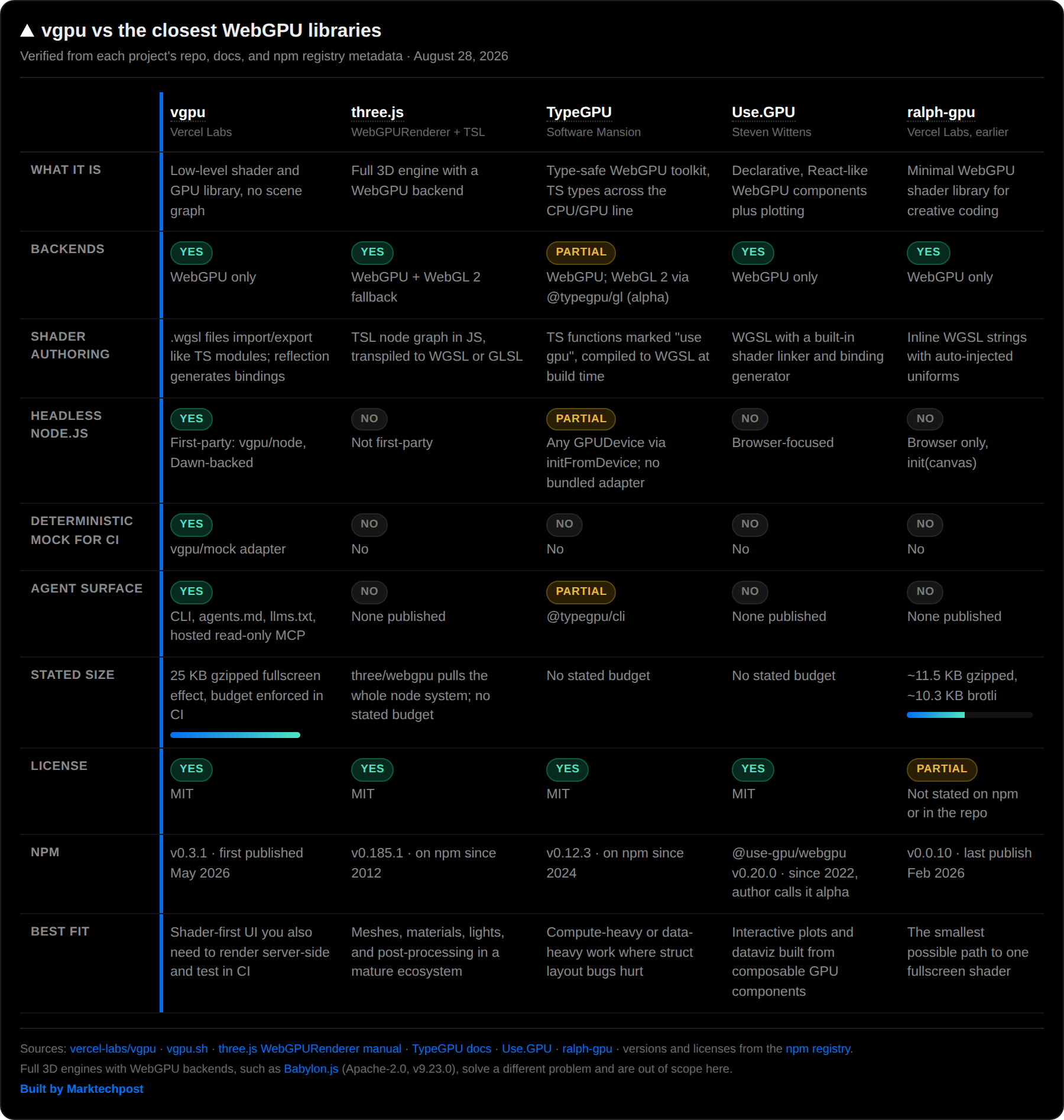
Vercel open-sources the vgpu WebGPU library for shader development

Vercel has released vgpu as open-source software, based on the WebGPU tooling it developed for shaders on vercel.com. The TypeScript library treats WGSL files as importable modules and provides one Gpu context for browser canvases, headless Node.js through Dawn, and deterministic CI tests. It is MIT licensed, available on npm as v0.3.1, and is a library rather than a hosted service, so it does not require an account, quota, or inference billing.

The Verge

EPA plan could reduce public notice for data center pollution permits

The US Environmental Protection Agency plans to remove a federal requirement for public notice and comments when some industrial facilities seek air permits. The proposed change would shift responsibility to state and local air agencies, which would decide whether communities must be informed about certain new pollution sources. EPA Administrator Lee Zeldin said the move would give authorities closest to affected communities more control and reduce regulatory burdens.

TechCrunch

Federal judge rejects Anthropic supply-chain risk designation

A federal judge in California has ruled that the Trump administration acted illegally when it designated Anthropic as a supply-chain risk. U.S. District Judge Rita Lin said Defense Secretary Pete Hegseth’s decision amounted to unlawful retaliation against the AI company, violating the First Amendment. She also described the action as arbitrary and capricious and found that Anthropic had been denied due process under the Fifth Amendment.

TechCrunch

Meta’s India and Southeast Asia chief joins OpenAI

Sandhya Devanathan, Meta’s vice president for India and Southeast Asia, is leaving the company to join OpenAI. Based in Singapore, she will report to OpenAI Asia-Pacific managing director Kiran Mani and oversee consumer growth, enterprise adoption, partnerships, regulatory engagement and operations across Southeast Asia and Australia.

The Decoder

San Francisco court rules Pentagon’s Anthropic blacklist unlawful

A federal court in San Francisco has ruled that the Pentagon acted unlawfully when it classified Anthropic as a supply chain risk. According to CNBC, the court found that the Department of Defense violated the First Amendment by placing the company on its blacklist in retaliation for Anthropic’s public criticism of government policy on artificial intelligence.