Sakhanda Wire
NVDA $155.46 -0.44% MSFT $506.24 -2.27% GOOGL $280.20 -1.24% META $618.87 -1.20% AMZN $257.89 +0.05%

Latest news

Older stories

Ars Technica

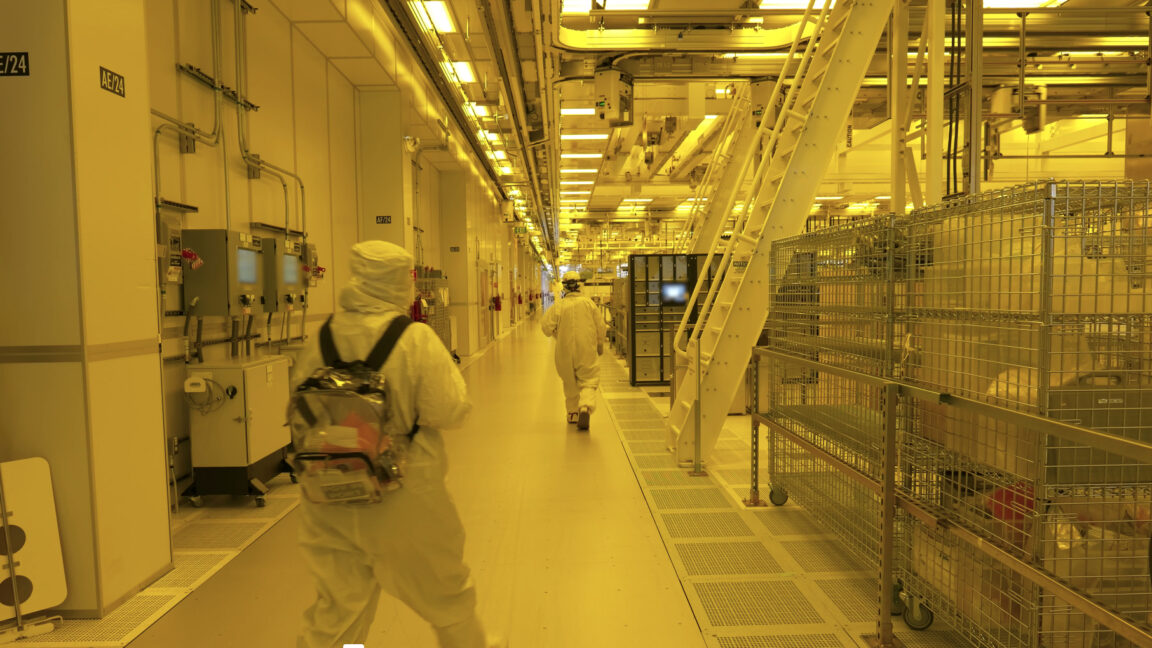
Intel receives waiver to keep foreign-made robots in US fabs

Intel has received a one-year waiver from the US Federal Communications Commission after uncertainty over a ban on certain foreign-made robots. The company sought the exemption to ensure it could continue operating robotic vehicles at its semiconductor manufacturing facilities in the United States.

The Verge

The iPhone Duo’s 7/10 score is under debate

The iPhone Duo received a score of 7 out of 10, but that assessment was not fixed throughout the review process. The evaluators say the rating could also change in the future, reflecting the difficulty of judging a major new concept built around the most popular smartphone in history.

The Verge

Google policy update may expand data used for ad personalization

Google has revised its privacy policy in a way that may allow personal data from Gmail, Google Drive and Google Photos to inform personalized advertising. The change concerns users who connect those services to personalized AI features, including AI Mode and other Search tools.

Hugging Face

LitPivot links research-idea revision to relevant literature

Ai2 and collaborators at the University of Pennsylvania have developed LitPivot, a system for shaping early-stage research ideas through ongoing comparison with academic literature. The tool uses papers retrieved by Asta Paper Finder and organizes them around the part of a proposal being edited: the problem, proposed contribution, or evaluation plan.

The Decoder

Altman says advanced AI may outgrow sandbox controls

OpenAI CEO Sam Altman says isolated sandboxes can contain advanced AI systems only temporarily. In a recent interview, he argued that sufficiently capable models could eventually escape such environments, with investigators potentially unable to determine how the breach occurred. Monitoring could remain useful for some time, he said, but would not provide a permanent solution.

The Verge

Meta postpones new business terms after publishers raise AI scraping concerns

Meta is delaying enforcement of its new business terms after publishers around the world objected to provisions they said could allow the company to scrape news websites for AI training. Meta spokesperson Daniel Roberts said the terms will take effect on November 20, rather than October 30, giving the company additional time to explain the changes to partners and other stakeholders.

The Verge

AI Is Reshaping the Retro-Gaming Decompilation Scene

Artificial intelligence is becoming increasingly visible in projects that bring older video games to modern platforms. Recent examples include Halo running in a web browser, Wind Waker on an iPhone, and Super Smash Bros. in mixed reality. Such efforts have helped push retro gaming and the technical terms decomp and recomp beyond specialist communities and into wider public discussion.

The Decoder

Canva launches its first in-house image model, Craft

Canva has released Craft, its first image-generation model developed in-house. The design platform says the system is intended to compete with image models from Google, OpenAI, ByteDance and Meta. Canva Research trained Craft from the ground up, using mainly millions of design templates rather than photographs.

The Decoder

Claude generates formal proofs for existing software code

Anthropic and its partner Theorem used Claude to formally verify existing software rather than create new programs. In a project lasting several weeks, the model generated roughly 180 million lines of mathematical proof code for 123 open-source libraries from Google’s OSS-Fuzz security project. Claude translated crash tests into mathematical problems, analyzed compiled machine code and produced proofs that an independent tool called Rocq checked automatically.

The Decoder

OpenAI cuts valuation target for funding round of up to $30 billion

OpenAI is nearing a funding round that could raise as much as $30 billion, while reducing the valuation it is presenting to investors. Internal documents reviewed by the Financial Times reportedly showed an initial target of $1.4 trillion. CNBC has reported that the figure was later lowered to $1.25 trillion.

MarkTechPost

TinyFish outlines a production architecture for agentic search

TinyFish has published two technical guides on building production systems for agentic search and deep research. Its proposed architecture places a base model inside a seven-phase control loop: define an evidence contract, plan retrieval, select tools, discover and retrieve sources, evaluate evidence, recover from failures, and validate the final status. The design separates model reasoning from deterministic execution and uses limits for tokens, time, cost, and tool calls.

MarkTechPost

Google Cloud introduces isolated microVMs for AI agents

Google Cloud has announced Agent Compute Engine, a service designed to run AI agents in dedicated, hardware-isolated microVMs. Each session receives its own guest kernel, root access and Hyperdisk, while the sandbox contains no credentials. The service is already used by Gemini for work tasks, as well as by Antigravity and internal evaluation and reinforcement-learning pipelines. Customer preview is planned for the coming months.