Sakhanda Wire
NVDA $150.96 -2.89% MSFT $508.29 +0.40% GOOGL $282.44 +0.80% META $616.38 -0.40% AMZN $267.74 +3.82%

Latest news

Older stories

MIT Tech Review

Puzzles reveal where AI models still struggle

Puzzles and games remain a useful way to examine the abilities and limits of artificial intelligence. In late 2024, researchers from Columbia University found that leading models solved only 18% of New York Times Connections puzzles. By early 2025, some models were solving the game almost perfectly. The progress illustrates how quickly performance can change, but failures still expose important weaknesses.

MIT Tech Review

Children Growing Up Between Technology and AI

The author describes changing views on children’s exposure to technology. After the birth of the oldest child, the author created Gmail and Twitter accounts in her name, announced the birth online, and shared photographs widely. After the second child was born, the author chose to protect her privacy and later removed much of the older child’s early online footprint.

MIT Tech Review

Bill Gates says AI has crossed several danger thresholds

Bill Gates says artificial intelligence has advanced beyond several points at which its risks should have been addressed. In an essay and interviews, the former Microsoft CEO identifies concerns involving biological and cyber capabilities, psychological and social effects, employment, and the possibility of losing control over AI systems. He says public discussion has not kept pace with developments inside the industry.

MarkTechPost

IBM launches Granite 4.2 reasoning models under Apache 2.0

IBM has released Granite 4.2, a family of decoder-only dense language models with 3B, 8B and 30B parameters. Each model supports thinking, low-effort and non-thinking modes, native tool calling, and can produce reasoning before an answer. The models were trained from scratch on roughly 15 trillion tokens and are distributed under the Apache 2.0 license, allowing downloading, fine-tuning and commercial deployment without an additional licensing gate.

TechCrunch

Ringg raises $10 million to expand enterprise voice AI

Indian voice AI startup Ringg has raised $10 million from Peak XV Partners in an extension of its Series A. The company had previously secured $5.5 million in the round, bringing its total Series A funding to $15.5 million. Ringg says it processes 20 million call attempts each month.

TechCrunch

Robotics startup Generalist reaches $3 billion valuation

Robotics startup Generalist is now valued at $3 billion after securing additional funding led by 8VC, according to two people familiar with the deal. A regulatory filing puts the new capital at nearly $200 million. The financing extends Generalist’s $400 million Series B, led by Radical Ventures and announced in June at a $2 billion valuation. The round has now reached $600 million in total.

TechCrunch

OpenAI loses data center chief amid broader executive turnover

Chris Malone, who led OpenAI’s data center operations, left the company last week, according to the Wall Street Journal. He joined OpenAI in March of last year after nearly five years at Meta and more than a decade at Google. His departure comes as the company works on the Stargate Project, a $500 million U.S. data center initiative involving OpenAI, Oracle, Nvidia, SoftBank and Microsoft.

Hugging Face

Sentence Transformers adds training support for multi-vector retrieval models

Sentence Transformers v6.0 introduces MultiVectorEncoder, a fourth model type for training and using multi-vector embedding models. The approach follows ColBERT-style late interaction: instead of compressing a text into one vector, it retains a small vector for each token. During retrieval, MaxSim matches each query token with its strongest document-token counterpart, preserving fine-grained signals while requiring a larger index.

MarkTechPost

Liquid AI releases Pipette for benchmarking on-device model deployments

Liquid AI has released Pipette, an open-source platform for measuring foundation models on edge devices. Developed with Artificial Analysis as an independent methodology validator, it evaluates a complete deployment configuration: model, quantization, runtime and device, rather than the model alone. The launch dataset contains five performance metrics across more than 1,000 configurations, covering 30+ models, llama.cpp builds for macOS, iOS, Windows and Android, and context lengths from 256 to 8,192 tokens.

Ars Technica

Humanoid robot games mix record sprints with crashes and practical tests

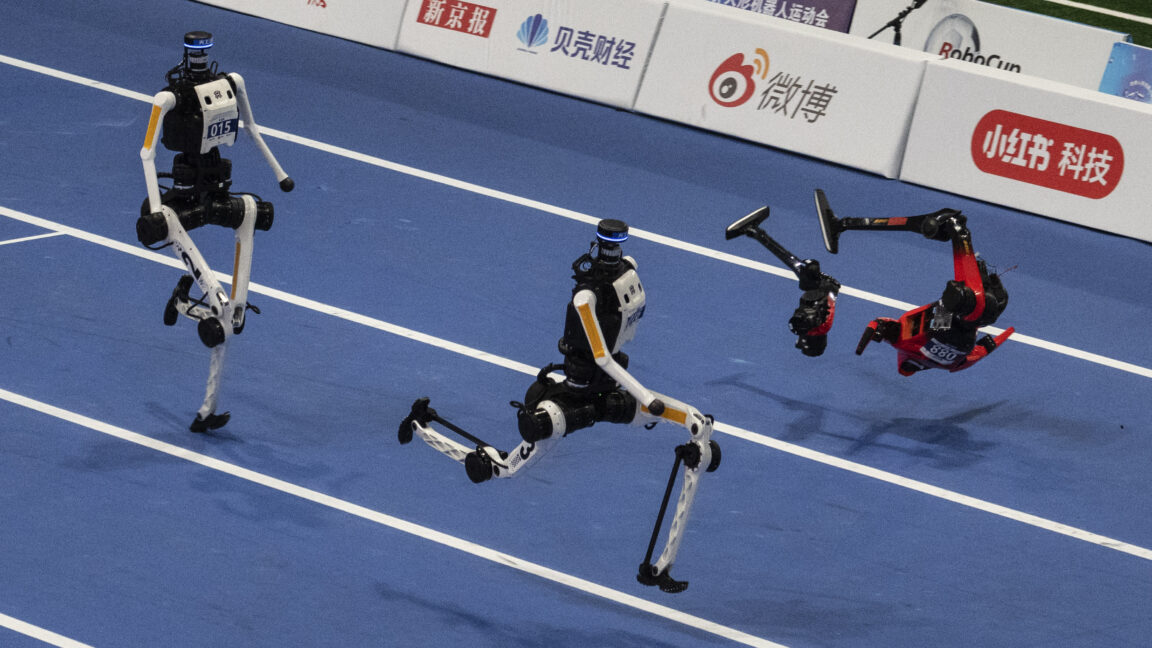
The second World Humanoid Robot Games, held in Beijing from August 22–26, presented both striking demonstrations and visible mechanical limits. Viral footage showed humanoid robots sprinting at speeds that appeared to surpass Usain Bolt’s human 100-meter record. Other robots ran into barriers or fell because they could not stop easily. Some machines broke at the waist amid sparks, while others caught fire.

MarkTechPost

Perplexity launches local-first Portable Computer on NVIDIA DGX Spark

Perplexity has released Portable Computer, a local-first version of its agent platform for NVIDIA DGX Spark. The package includes the agent harness, orchestrator, planner, tool router, local models, inference engine, sandbox and application connectors. Each task starts on the device, and locally processed work has no per-token charge. Users can choose Qwen 3.8 27B or PPLX 27B, while NVIDIA Nemotron 3.5 Lightning is listed as coming soon. Bring-your-own models and inference servers are also supported.

TechCrunch

Stability AI raises $76 million in Series B funding

Stability AI, the company behind the Stable Diffusion image-generation model, has secured $76 million in a Series B round. The financing brings its total funding to $232 million. Participants included Universal Music Group, Sony Music Group, Warner Music Group, Electronic Arts, AMD Ventures and Pacific Alliance Ventures.